

Last Updated on May 28, 2026
Rental income tax in Ireland
Are you an Irish resident or a non-resident with property in Ireland? Being a landlord means significant responsibility – and complex rules regarding tax on rental income in Ireland.
Property taxes are a complicated business, especially if you are a new homeowner.
The thought of figuring out allowable expenses, filing deadlines (Form 11 vs. Form 12), and minimizing your liability can feel intimidating, especially for first-time or non-resident landlords.
That’s where this definitive guide comes in. We break down the complex rules into clear steps, ensuring you understand your tax on rental income in Ireland, liabilities, claim every expense you’re entitled to, and meet all filing requirements.
Rental income tax Ireland: Key points for landlords
-
Tax rates: Rental income is subject to income tax (20% or 40%), PRSI (4.35%), and USC.
-
Allowable expenses: Deduct costs like repairs, management fees, and 100% of mortgage interest.
-
Non-resident landlords: Different rules apply; often, income is taxed at source by tenants or agents.
-
Filing deadline: Generally, October 31st each year.
- Importance: Proper filing avoids penalties from revenue.ie.
I am renting out my property in Ireland. What are my property tax obligations and what should I do about tax on rental income Ireland?
You will have to pay Irish landlord tax. This is determined by subtracting all tax-deductible expenses from the gross rent. The rental profit is added to your other income and taxed at your top tax rate.
You must declare your rental income to Revenue using one of the following methods:
- Self-assessed taxpayers should use Form 11 to report their income
- For PAYE employees, use Form 12
You will also have to register your property’s letting annually with the RTB (Residential Tenancies Board). This is a legal requirement that is crucial for tax purposes.
If you are receiving Mortgage Interest Tax Credit (if you were previously living in the property as your primary residence) on your mortgage, it is important to contact Revenue and request to cancel it. When renting out your home, you are not eligible for MITRS.
Also, make a list of all the furniture, including how much it costs and when you purchased them.
You should keep receipts for all expenses spent while renting out the home, such as – fees for letting agents, fees for services, the registration cost for the RTB, costs of repairs, mortgage interest certificates, and advertising.
Example Deductible Expenses:
- Property management fees: If you pay an agent to manage your property, these fees are fully deductible.
- Insurance costs: Premiums for building, contents, and public liability insurance.
- Repairs & maintenance: Costs for fixing a leaky roof, repainting between tenants, or repairing appliances are deductible. (Note: Improvements are generally capital, not revenue expenses).
- Mortgage interest: For residential properties, 100% of qualifying mortgage interest is deductible from rental income.
The Financial Checklist: How to Rent Out Your House in Ireland Legally
Requirements a new landlord must complete:
-
Register the tenancy with the Residential Tenancies Board (RTB) within the required timeframe.
-
Check local Rent Pressure Zone (RPZ) caps to determine your maximum rent allowance.
-
Determine your tax residency status to see if you require an Irish Collection Agent.
-
Maintain an explicit record of all eligible pre-letting expenses and capital allowances.
What is the rental income tax rate in Ireland? How much tax do I pay on rental income?
The tax rate on rental income up to the standard cut-off rate is 20%. Income earned after this cut-off point is taxed at 40%.
In addition, you must pay PRSI (4.35%) and USC.
Example for tax rate:
“Example for 2026 Tax Rates: For the 2026 tax year, rental income is taxed at standard rates. For instance, if you are a single person and your total income (including €25,000 net rental profit) is under €44,000, the rental portion is taxed at 20%. If your total income exceeds this, the portion above €44,000 is taxed at 40%. You will also apply 4.35% PRSI and the 2026 USC rates (which range from 0.5% to 8%). Don’t forget to claim the €1,000 Landlord Tax Credit (RPRIR) to reduce your final bill.“
What are the PRSI and USC rates on rental income?
If you are an Irish tax resident, you will be liable for PRSI (Pay Related Social Insurance) of 4.35% on your rental income profit.
The Rule for 2026: PRSI for self-employed/landlords (Class S) is 4.20% for the first nine months of the year. It is scheduled to increase to 4.35% on 1 October 2026.
Non-residents are not liable for PRSI.
If you are a non-resident landlord, you are obligated to pay the Universal Social Charge (USC) only when your annual Irish income, which encompasses rental income, exceeds €13,000.
Depending on your other income, the rates of USC (Universal Social Charge) range from 0.5% to 8%. For 2026, the 2% rate ceiling has been increased to €28,700 to ensure low earners stay out of the higher brackets.

Is the rental deposit in Ireland subject to taxation as well?
Generally, landlords do not report rental income deposits on their Irish property tax declaration.
However, if a deposit is forfeited (e.g., to cover unpaid rent or damages), that amount becomes taxable income and must be declared. Furthermore, if you use a retained deposit to pay for a repair, you can still deduct the cost of that repair as an expense, but you must first include the retained deposit as part of your gross rental income.
When should I pay rental income tax?
If the earnings from renting out your property are your main source of income and you are self-employed, then you must pay your rental income tax in October, once a year.
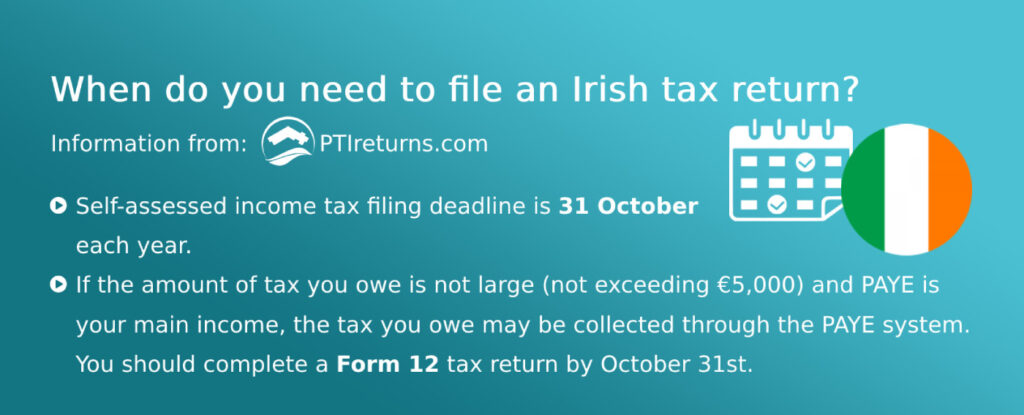
The deadline to file tax on rental income Ireland is 31 October each year. However, if you file and pay through the Revenue Online Service (ROS), the deadline is extended to 19 November 2026.
In some cases, if the amount of tax you owe is not large (does not exceed €5,000) and PAYE is your main income, the tax you owe may be collected through the PAYE system. You should complete a Form 12 tax return by 31 October.
Which form should I file if my Irish rental income exceeds €5,000?
If your net rental income exceeds €5,000 (or your gross rental income is over €30,000), you must file tax on rental income Ireland returns and complete Form 11.
If you are a non-resident landlord and your tenant pays you directly, they are required to deduct tax at the usual rate (20%) from the rent and report it to Revenue.
Non-resident landlords no longer use Form R185. Since July 2023, the NLWT (Non-Resident Landlord Withholding Tax) system is in place. Your tenant or non resident landlords collection agent must submit a Rental Notification (RN) and pay the 20% tax via ROS within 21 days of each rent payment. This tax is then automatically credited to your account for your annual Irish self-assessment tax return.
What expenses can landlords in Ireland claim?
Allowable xxpenses for Irish rental properties that could maximize your deductions can be:
- Maintenance and repair expenditures
- Utilities and other service charges
- RTB (Residential Tenancy Board, formerly known as RTB – Private Residential Tenancy Board) registration fees
- Advertising costs and estate agent fees
- Wear and tear
- Capital allowances on furniture and fittings
- Insurance premiums
- Management fees
- Mortgage interest
- Certain mortgage protection policy premiums
- Expenses between lettings in certain circumstances
- Certain pre-letting expenses on vacant premises
- Accounting and legal fees
You must provide proof and receipts for each deduction that you would like to claim on your Irish property tax declaration.
Should I be RTB registered?
Yes. Within one month of the tenancy’s start date, all landlords must register the new tenancy.
On your Irish income tax return, you can claim the full amount of both the initial fee and the sum you paid per tenant as an allowable expense against your rental income.
Some expenses can only be deducted if you’re registered with the RTB.
You can get a refund for both the initial fee and the amount you paid per tenant if you register with the RTB.
Which expenses cannot be claimed?
Some of the costs you cannot claim include:
- Costs before and after the rental of the property (post-letting expenses)
- Local Property Tax (LPT)
- Costs for your labor when maintaining the real estate
- Stamp Duty (It is a tax that must be paid when you buy a home. This expense is not deductible. Any legal aid you obtain in respect to Stamp Duty, on the other hand, is tax-deductible)
- Interest from the time you buy the property until it is rented out for the first time
How can I claim my rental expenses in Ireland?
You must fill out Form 11 or 12 (depending on your circumstances) to claim your expenses.
As mentioned above, it’s very important to organize and keep all the receipts and invoices relating to the rental expenses.
A tax expert from PTI Returns can help you with all the tax documentation.
I am renting out an Airbnb property. Do I have to pay real estate tax in Ireland?
Yes, you should be declaring your Airbnb rental income and the room exemption (Rent-a-Room Relief) cannot be applied in this case.
However, there are several expenses that you can deduct from your Airbnb earnings to lower your tax liability. Some of them are:
- Repairs and maintenance
- Agent fees
- Utilities
- Local service charges
- Advertising
- Insurance
- Mortgage interest etc.
To claim a tax deduction, make sure you keep all your receipts and track your expenses.
A tax advisor from Property Tax International can help you with all this.
What is the Rent-a-Room Relief in Ireland?
If you are renting out a room or several rooms in your own house, you can claim the Rent-a-room relief and through this scheme, you can earn up to €14,000 gross tax-free. This €14,000 limit includes not just the rent, but also any payments for food, laundry, or utilities provided to the tenant. However, if your gross revenue exceeds this limit by even one euro, the entire amount becomes taxable. Furthermore, as of 2026, it is strictly enforced that this relief does not apply to short-term lets (under 28 days), such as occasional Airbnb hosting, unless the guest is a student or there for a long-term residential purpose.
If you claim this relief, you cannot deduct expenses from your rental revenue.
Note for 2026: To qualify for the relief, the room must be used for “residential purposes.” This generally means the tenant must stay for more than 28 consecutive days. Exceptions are made for students (including those in “digs” for 4 days a week) and those receiving respite care.

Read also: Can you avoid paying tax on rental income in Ireland
Do I have to pay rental income tax if I’m a non-resident landlord in Ireland?
Yes. If you are a non-resident landlord in Ireland (regardless of where you live), you should declare your rental income both in Ireland and your home country, and you have several options:
- One option is to appoint an “Irish rent collection agent” to handle rent collection and tax filing (PTI Returns provides this service to non-resident landlords).
- Alternatively, tenants can deduct the rental income tax (20% rate) from their rent and pay it directly to the Revenue Commissioners on the landlord’s behalf.
The landlord can later claim this as a credit when filing tax return for landlords in Ireland. In either case, it’s crucial to note that the tax return on rent must be filed and paid by 31 October each year.
Tenants or agents now use the NLWT (Non-Resident Landlord Withholding Tax) digital system. Instead of a paper certificate, they submit a Rental Notification (RN) online every time they pay you. This tax is automatically credited to your PPS number in the Revenue system.
- You can choose a property tax professional like Property Tax International with 25+ years of experience in international tax and with our help, you can file rental income tax return online.
What about the international tax relief agreements between Ireland and other countries?
Over 70 countries have tax treaties with Ireland. These double taxation agreements ensure that income that has already been taxed in one country is not taxed in another.
A tax credit or exemption from tax may be available on certain types of income under a tax treaty, in either:
- your home country
or
- in the country where you earned the income
What are the changes for UK resident landlords of Irish properties after Brexit?
After Brexit, most UK resident landlords in Ireland will be subjected to the 20% standard rate of tax.
What are the U.S. tax obligations for owners of Irish properties?
You must continue to file U.S. expat taxes if you are a U.S. citizen with property in Ireland.
On your U.S .expat tax return, you must list all worldwide revenue, including income that is taxed in Ireland.
There are tax credits and deductions related to income earned in Ireland that may decrease your U.S. taxes.
What are capital allowances?
If you have paid for equipment, furniture, or white goods for your rental real estate, you may be able to claim these as capital allowances (wear and tear allowances or depreciation). For the time being, this wear and tear allowance is 12.5% of the cost per year, for a maximum of eight years
Example: Assume you spent €1,000 on a new refrigerator for your kitchen. You can now claim capital allowances of €125 each year for the next 8 years.
What is the Local Property Tax in Ireland – LPT?
The Irish Local Property Tax (LPT) is a tax levied on the market value of residential real estate. The term “residential property” refers to any building or structure (or part of a building) that is used as, or is appropriate for a residence.
Revenue does not evaluate properties for LPT purposes, but it can help you determine how much your property is worth.
Do I have to pay LPT?
You are liable for Local Property Tax (LPT) in 2026 if you possess a residential property as of November 1, 2025.
All homeowners, even those who own rental homes, are responsible for paying the tax. Even if you don’t typically live in the property, you are still responsible for paying LPT.
Joint owners must choose one of them to serve as the designated liable person. This person is responsible for submitting the local property tax returns and making the payments.
In some cases, you must pay the LPT if you are not the owner:
If you are a renter and your lease is less than 20 years, you are not subject to LPT. However, you are responsible for LPT if your lease lasts 20 years or more.
You are also not responsible for LPT if you are renting a home from your local government.
Property owners cannot avoid paying LPT, and Revenue has made it clear that those who do not will be pursued and penalized.
When should I pay LPT?
1 November is the annual Local Property Tax (LPT) liability date. If you are the person who is liable for LPT on 1 November 2025, you must pay the LPT fee for 2026. If you are the owner on 1 November 2025, you are liable for the 2026 payment.
You will be charged a 10% surcharge on your income tax return if you do not file and pay your LPT before the deadline.
What are the bands for Local Property Tax in Ireland?
The tax you owe depends on how much your property is worth on November 1, 2025.
This value is used to calculate your Local Property Tax (LPT) for the years 2026 to 2030.
The tax you owe depends on how much your property was worth on November 1, 2025. This value is used to calculate your Local Property Tax (LPT) for the years 2026 to 2030. For the valuation period of 2026 to 2030, there is a corresponding basic LPT rate for each band.
The rates for each of the 19 bands for properties up to €1.75 Millions are displayed in the table below.
| Band | New 2026 Valuation Range | New Basic LPT Charge | |||
|---|---|---|---|---|---|
| 1 | €0 – €240,000 | €95 | |||
| 2 | €240,001 – €315,000 | €235 | |||
| 3 | €315,001 – €420,000 | €315 | |||
| 4 | €420,001 – €525,000 | €405 | |||
| 5 | €525,001 – €630,000 | €495 | |||
| 6 | €630,001 – €735,000 | €585 | |||
| 7 | €735,001 – €840,000 | €675 | |||
| 8 | €840,001 – €945,000 | €765 | |||
| 9 | €945,001 – €1,050,000 | €855 | |||
| 10 | €1,050,001 – €1,155,000 | €945 | |||
| 11 | €1,155,001 – €1,260,000 | €1,035 | |||
| 12 | €1,260,001 – €1,365,000 | €1,189 | |||
| 13 | €1,365,001 – €1,470,000 | €1,408 | |||
| 14 | €1,470,001 – €1,575,000 | €1,627 | |||
| 15 | €1,575,001 – €1,680,000 | €1,846 | |||
| 16 | €1,680,001 – €1,785,000 | €2,064 | |||
| 17 | €1,785,001 – €1,890,000 | €2,283 | |||
| 18 | €1,890,001 – €1,995,000 | €2,847 | |||
| 19 | €1,995,001 – €2,100,000 | €3,110 | |||
| 20 | Over 2,100,000 | Calculated by rates (see below) |
If your property is valued at over €2.1 millions, the tax is based on its actual value, not a specific range. The charge is calculated as follows:
- 0.0906% of the first €1.26 million of the property’s value
- 0.25% of the portion between €1.26 million and €2.1 millions
- 0.3% of the portion exceeding €2.1 millions
What is Capital Gains Tax in Ireland – CGT?
Capital Gains Tax (CGT) in Ireland is a tax imposed on the profit (capital gain) made on the sale of any asset. The current CGT rate is 33%, and it is paid by the individual who disposes of the property.
The gain (the difference between the amount you bought for the asset and the price you sold it for) is taxable.
The standard rate of Capital Gains Tax is 33% of the chargeable profit you make.
PTI Returns can help you guarantee that your CTG tax return accounts for all deductible expenses to lower your CGT burden, or, more importantly, if you have a CGT loss, we can ensure that it is filed and available to be used against future gains.
Should I file a rental property tax return in Ireland?
Yes, you are obliged to file a rental income tax return, if you earn any money from your real estate unless it’s through the Rent-a-Room Scheme and you live in the house as well.
What about taxes on rent from foreign properties outside the Republic of Ireland?
If you are an Irish resident with properties abroad, your rents will be taxed on the same basis as Irish properties.
You will have to pay rent income tax, which is determined by deducting all tax-allowable expenses from your gross rent.
If you own real estate in different countries, you should know that all foreign properties are lumped together regardless of where they are.
If you have a rental loss on a foreign property, you can only offset it with future rental earnings on the same property. They cannot be deducted from rental income earned in Ireland.
How long should I keep records of my rents and expenses for Revenue?
You should keep records at least for the last 6 tax years.
What will Revenue look for if I am audited?
They’ll require copies of your leases, all of your receipts, proof of your RTB registrations, and copies of your bank statements and rental accounts.
How can I file a rental income tax return online and claim my tax refund?
You can file your property tax return in Ireland yourself.
However, managing your tax papers on your own might be very tough. You will be fully responsible for ensuring that you receive all of the tax benefits and credits to which you are entitled.
Alternatively, if you would like assistance, you could use the services of tax advisors specializing in property taxes.
Are you looking for property tax experts near you? We are here!
PTI Returns can help you file a rental income tax return online and claim your refund, no matter if you are an Irish resident or non-resident.

Why choose PTI Returns?
Save time and stress – Our property tax specialists will handle all the tricky tax paperwork
Peace of mind – Property Tax International (PTI Returns) is part of CluneTech (formerly known as Taxback Group), employing over 1,500 people in more than 20 countries worldwide. We have more than 25 years of experience in international property tax and we will keep you compliant with the Revenue
Convenient service – Our service is online and we will transfer your tax refund straight to your bank account anywhere in the world
Your questions answered – If you have any questions that we did not answer, you can request a free callback from our tax experts at +353 1 635 3722.
Also, find out about our special irish rent collection service for non-resident landlords.
For regular tax tips and deadline, reminders follow us on Linkedin or Facebook.
Want to learn about our online property tax return filing service?
When you apply through this contact form a Property Tax International tax specialist will contact you.